Showing posts with label transcription. Show all posts

Tuesday, April 27, 2010

NEW FREDDIE KING TRANSCRIPTION NOW AVAILABLE, "NICKEL-PLATED"


I just finished a new transcription-- one of Freddie King's great blues instrumentals. Excerpt at right, the whole thing is six pages. See the catalog for ordering info--

karlstraubguitar.blogspot.com/2010/01/catalog-of-available-transcriptions.html
(MORE)

Tuesday, September 15, 2009

HANK GARLAND TRANSCRIPTION BOOK, "VELVET GUITAR" ALBUM

Guitarist Mike Joiner has done guitar transcriptions from Hank Garland's "Velvet Guitar" album.

Hank was a true musician's musician-- aside from playing on countless Nashville country sessions, he made a handful of top-notch jazz recordings before a car accident in 1960 made it impossible for him to play professionally. Garland's "Jazz Winds from Another Direction" is his most celebrated jazz album, but the "Velvet Guitar" lp has some beautiful playing as well. This album, currently available as part of the "Move" two-disc collection, may have been originally promoted and packaged as a "mood music" type of record, but it's nonetheless excellent. It actually has one advantage over the more well-known "Jazz Winds;" Garland is virtually the whole show. Impeccable single-note lines alternate with hip double-stops and some of the sweetest chord melody playing I've ever heard.

I'm looking forward to spicing up my playing with as many of these Hank Garland licks as I can steal!


Mike's notation/tab book is in PDF form. Anyone interested can contact Mike Joiner at jazzguitarist27@yahoo.com.


Here's a sample from Mike's book. "Ed's Place" is a slow and swinging blues. The hammer-ons and pulloffs are a great example of how to use slurs to get a bluesy jazz flavor. Listen to the track here--

www.karlstraubmusic.com/2-03 Ed's Place.mp3

click on "MORE" to see track listing from Mike's book.


. The tracklisting is:

1. Secret Love
2. Scarlet Ribbons (For Her Hair)
3. Greensleeves
4. Tammy
5. Polka Dots And Moonbeams
6. Autumn Leaves
7. Like Someone In Love
8. Ain't Nothing Wrong With That, Baby
9. Blame It On My Youth
10. Ed's Place

(MORE)

Friday, December 12, 2008

JUNIOR BARNARD GUITAR SOLO TRANSCRIPTION


Lester "Junior" Barnard is not only one of my favorite obscure guitarists, he's one of my favorite guitarists, period. Junior played with Bob Wills and the Texas Playboys, notably on a classic series of radio transcriptions that have come to be known as the
"Tiffany Transcriptions." The Tiffany recordings were among the best work Wills ever did. Possibly because there were no record company weasels around to kill the mood, Wills and his band recorded in a looser, more raucous vein than most of his other studio dates. They rerecorded many Wills standards, along with the usual eclectic mix of pop, folk, blues, swing, and fiddle/dance material; these sides, bursting with great improvised solos and Wills humor, have the flavor of sitting on the floor at a private party.
Wills had many fine soloists in his western swing bands over the years, but even in that august company of redneck jazzmen Junior stands out. Blues had always been an influence on country music, since long before it was called "country," but Junior was one of the first country players to embrace the trashy distorted approach to blues.


www.karlstraubmusic.com/girl i left behind me junior solo.mp3

Some of the more rough-hewn r&b and blues players were cranking up their amps for a dirty sound in the 1940s, but this was still a pretty new phenomenon and Junior must have really sounded weird to the country audience. Along with the dirty blues sound, Junior had a strong sense of swing. The thing that makes him important to me as an influence is that he combined the trashy side of blues with articulation and timing that are jazz and country at the same time. He may be the first player that mixed the idioms up in quite that way-- although I don't know if Chuck Berry ever heard Junior play, there are some moments in Junior's work (especially on "Barnard Blues" ) that come pretty close to rock and roll. Berry was reportedly influenced by a Wills recording of "Ida Red;" I'm just not sure if he heard a version with Junior. You can hear the connection on Chuck's first single "Maybelline." Supposedly a lot of people, including some rockabilly musicians, heard this single on the radio and assumed Chuck was a redneck.

TIPS ON PLAYING THE TRANSCRIPTION

first two bars are seventh position, with one grace note slide from the sixth fret. (for discussion on position playing/fingering, see the post about perpetual motion etudes. ) 3rd bar is 8th position, with one tricky alternate fingering-- with index waiting to play B8, middle finger plays D8 and ring finger hammers D9. then shift into normal 8th position fingering. 4th bar is 10th position at first, try to use pinky for B12 and ring for G12, then reach back to G9 with index. slide on G string with middle finger to 11th fret-- you're now briefly in 10th position again. 5th bar slides with pinky to 15th fret-- dig into this note. Junior is playing out of a G shape at this point-- the 6th bar is Chuck Berry/B.B. King territory, sort of a bluesy but sweet sound-- major pentatonic, except that like blues players, Junior bends the B note slightly flat.
7th bar-- a bend and release, or "unbend" as like to call it. ( this in the middle of an otherwise Charlie Christian-type line!)
8th bar-- quarter notes. many novice players see a bar like that, especially when it's in the middle of a bunch of more complicated stuff, and tend to play it lazily. in fact, quarter notes can and should swing and they should definitely be played with gusto. (see the work of Thelonious Monk for more of this. ) Dig into those quarter notes-- Junior did. the two notes in the 9th bar were played with such energy that we can overlook the fact that the last note, a G sharp, was probably a wrong note. (I'd speculate that he was going for an A, the ninth of the chord. )

the second half of the solo features a Junior trademark-- double stops. (here's where you hear more Chuck Berry-esque sounds, and Merle Haggard has borrowed these licks from Junior). fingering is crucial with double stops. any time you have two adjacent strings with notes on the same fret, use your index finger as a mini-barre-- as in the first double stop, a major third interval. the next double stop, a minor third on the G and G strings, is middle and ring fingers. all of this should be played aggressively, once you have the fingering down. the next double stop, a minor third on the G and D strings, is played with index and ring.
the fingering from there should be more of the same. TIP ON ARTICULATION-- Junior digs in, often using a staccato approach that marks him as a country player. This generalization is too oversimplifying, but Junior digs in with a trashy amp sound (blues), swings(jazz), and uses staccato(country). when all of these elements are in place, he is literally in all three idioms at once, playing what Tommy Duncan calls "coal-mine choruses" in an often-quoted aside from the Tiffanys.

unfortunately, it's become very difficult and expensive to buy some of these Tiffany Transcription albums. (as far as I know, there are 10 volumes. ) I hope they come back in print, but in the meantime my friend Charlie McNamara says they are available on itunes.
(NOTE-- SINCE I WROTE THIS, THEY HAVE BECOME AVAILABLE AS A BOX SET ALSO.)


(MORE)

Wednesday, December 10, 2008

BACH COUNTERPOINT EXERCISE

www.karlstraubmusic.com/BACH COUNTERPOINT.mp3


This little gem comes courtesy of guitar guru John C. McCain (no relation to the Senator). It's an excerpt from J.S.Bach's Minuet in D minor, from his Anna Magdalena Notebook. John took this from the first three bars of Bach's original piece and arranged it for guitar. John's arrangement is the first example in open position. I have refingered it so it can be played all over the neck, and the second two examples show closed position versions in D minor. The first closed position example is on a lower set of strings than John's open position version; the second follows his string sets an octave higher. The last example is the first closed position example, but transposed to G minor. Both of these closed position versions can be played all over the neck. The same fingerings can be used for all twelve keys, although some keys might be awkward or impossible on guitars without a cutaway. To put them in any key you want, find the tonic note of your new key on the A string, or D string, and then use the same fingerings as in my examples.


a few fingering tips-- in the open position, d minor, first bar-- ring finger on A, middle finger on E, pinky on D, ring on C#. this enables you to shift the middle/ring doublestop up a fret in the beginning of the next bar.

first moveable version-- same place in the music. ring/pinky for first doublestop, middle to C#, enabling you to shift ring/middle up to next fret in the second bar, and then index takes the next note.

second moveable version-- the same fingerings, more or less, as the open version should work. Index barre in the first measure enables you to hold the tonic note while the upper voice moves.

full disclosure-- i played these examples with a pick and fingers hybrid approach.

You can find music by John C. McCain at his myspace page.www.myspace.com/johncmccain


(MORE)

Friday, December 5, 2008

TWILIGHT ZONE THEME


www.karlstraubmusic.com/twilight zone.mp3
I've always wanted to be able to play the legendary "Twilight Zone" lick, and I've fooled around with it since I was a teenager. I finally decided to figure it out for real. it turns out I had it pretty close as a teen, but not exactly right--

(NOTE: see comment for one visitor's correction to my rhythmic notation. I haven't had time to check what he's saying to any great extent, but he could well be right. I maintain that his suggestion that the composition really begins on the "and" of 4 may be correct, but since the accents are on that first note, it's hard to hear it as a pickup, and if you play it as written here it will sound correct, regardless of Marius Constant's original intention. I hope I've understood his comment correctly, but I'm certainly willing to hear more about it if he wants to comment further.) TIPS-- I've written it out as two guitar parts, because that's presumably the way it was played originally. it can be played by one player, though, and it sounds good but you have to tweak your guitar a bit to play it in the same key as the show.

tune your two highest strings, B and E, up a half step to C and F. (this enables you to play both parts at once. if you try to play both parts in standard tuning, there's a note that's off the guitar neck. at least on my guitar it is! if you have 22 frets you can play what i have written, in standard tuning, but all of it one fret higher. you also have the option of not retuning, and playing as written, but it will be one key lower than the show. many of you may say, as i would have in my lazier early days, that it's not worth the effort. it really does sound better in the same key as the show, though. you'll also have to play the G string note one fret LOWER if you play it in standard tuning. in the end, I think it's easier to do it with the retuning. )

once you get the retuning out of the way, and puzzle out where the 17th fret is, etc. it's time to think about how the parts fit together. the trick is to play the top part in quarters and the bottom part in eighths. i play it with pick for the bottom line (eighths) and ring finger for the top line (quarters). this means you hold the top notes as long as two notes of the bottom part. this was the detail I missed when i tried to learn it years ago-- I was playing all of it as eighths, and if you do that it's almost right, but not quite.

INCIDENTAL MUSIC

I threw these in for fun, because I heard them on the dvd while I was trying to find the main theme of the show.
the first of the two is two double stops-- not too tricky as long as you use the right fingering. try left hand index and pinky for the first double stop, and middle and ring for the second. (I'm again using pick and ring finger. You could use thumb and finger if you want-- it will sound a little different.) this is a relatively simple example of a George Van Eps or Jimmy Wyble type contrapuntal fingering situation. (lest I appear pretentious by dropping their names, I'll admit that while I have tried some of their exercises, I'm pretty much in the kindergarten stage with their stuff. Still, I dipped into it far enough to have an easier time with the Twilight Zone lick. )

the second is a single note line-- use extreme muting, and observe the odd fingering where the last three notes are just moving the pinky up one fret at a time. originally I tried it with a more efficient fingering, playing those notes on different strings, but it somehow didn't have the right sinister quality.

A LITTLE THEORY AS TO WHY THE TWILIGHT ZONE MUSIC SOUNDS SO CREEPY


the three main kinds of dissonant intervals are whole step (two frets away), half step (one fret away), and tritone (the equivalent of six frets away). although my composition and theory teachers would shake their heads at my oversimplifying here, dissonance is when two or more notes together sound a little off, even wrong. this doesn't necessarily mean bad-- I like to think of dissonance as a strong spice rather than a rank smell-- but these kinds of dissonances would be out of place in a catchy pop song, or a nursery rhyme. the Twilight Zone theme has all three of these dissonances, and basically just alternates between them. there's more to the theme than just this little excerpt, but this is the guitar part-- everyone knows this part, and it sounds good by itself.

the first short incidental lick is a whole step dissonance followed by the more consonant (or the more musical, to the narrow-minded) interval of a major third. the alternating of the two intervals causes an appealing tension and release effect. It's interesting to listen to the contrast between this short idea and the more famous "theme" lick, which is all tension and no release.

My research says that the famous theme was composed by Marius Constant. He may have written these other two short "cues", as well. Bernard Herrmann and others also wrote music for the show, so the authorship of these short excerpts is not clear to me from the stuff I read online, but here's the link.
(Another tantalizing tidbit-- according to one source I found online, Howard Roberts was the session cat who played the TZ theme.)
www.classicthemes.com/50sTVThemes/themePages/twilightZone.html
for a relatively sane presentation of Twilight Zone info, see Sci-Fi.com website http://www.scifi.com/twilightzone/gallery/
index.php


if you feel comfortable with a much more obsessive Twilight Zone experience, check out http://www.twilightzone.org/index2.html (the episode index is really demented.)

(MORE)

HANK WILLIAMS INTRO IN TWELVE KEYS

Here's Bob McNett's great guitar intro from Hank Williams's "Mind Your Own Business." I've transcribed the original (key of E) and written it out in all twelve keys, in the circle of fourths order. (E, A, D, G, C, F, Bb, Eb, Ab, Db, Gb, B)

I've positioned it on the guitar to avoid open strings, although I think the original used some open strings. This was to make the fingerings transferable. The second half of the intro uses the same fingerings and string sets in each key, the first half I wrote out mostly coming off the G string, but once or twice I put it coming off the B string. This will give you two ways to do it, if you want. They sound slightly different.

Aside from the benefits of playing in the fifties country style, playing the same intro in twelve keys has numerous advantages. Playing through exercises like this is the best way to learn how to play in different keys, and how to transpose an idea to a different key without changing fingerings. I recommend playing them in the circle of fourths order, which helps you memorize how to find keys quickly. If you find yourself memorizing the fingerings (this should happen if you practice all the keys) make sure you always know what key you're playing in.


I talk a bit more about this intro in another post, on yet another blog that's even less developed than this one. here's the link.
karlstraubcountryguitar.blogspot.com/2008/12/hank-williams-lead-guitar.html
here's a website with info about Hank's great band the Drifting Cowboys.
www.angelfire.com/ny3/thedriftingcowboys/
(incidentally, that's where I picked up the fact that Bob McNett played this guitar intro. If anyone thinks it was played by someone else, they should comment here and I'll investigate.)

(MORE)
GUITAR DUET INTRO, "WOULDN'T IT BE NICE"


www.last.fm/music/The+Beach+Boys/_/Wouldn't+It+Be+Nice+(stereo+mix)

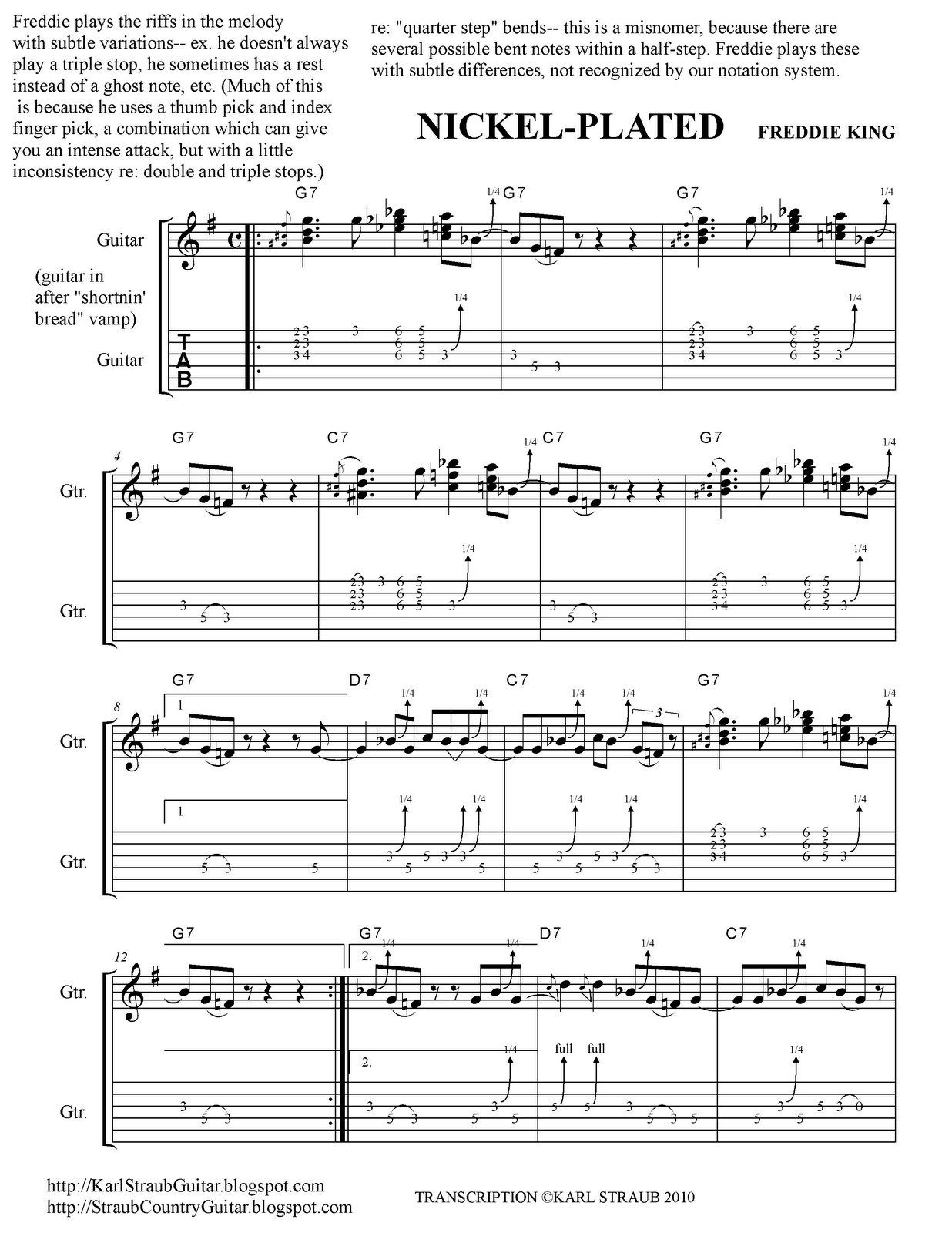
here's a transcription of the guitar duet intro to Brian Wilson and the Beach Boys's classic "Wouldn't It Be Nice." aside from being a stellar piece of music, the high part (guitar 1 in the transcription) is a great picking exercise for both hands. sort of like my perpetual motion etudes, except of course much better. both guitar parts are way up above the 12th fret, but the top part is written an octave below where it should be, with the designation 8va up. this means play an octave higher, but it's written this way to make it easier to read. (it's always wise to avoid leger line "snow blindness" if you can.)


TIPS--
guitar one--
first bar is all in 14th position.
2nd bar, reach up with pinky for the high B note, ring for G 17, index, pinky, ring, index, pinky, then reach down with index to move back to old position on last note of the bar.
3rd bar, same as 1st.
4th, middle on G13, then index, pinky, index, middle, pinky, index, middle.

guitar two all in 12th position.

IMPORTANT
-- the eighth notes here should be played in the manner of "swing eighths," which is the way jazz musicians generally interpret eighths. the feel here is not exactly swing, but it's sort of a stiffer kind of swing. the first of a pair of eighths should be interpreted as two eighth note triplets tied together, and the second of the pair is a single eighth note triplet. the attack should also be extremely clean, and I recommend alternate picking-- each pair of eighths is played with a downpick followed by an uppick. listening to the Beach Boys recording is essential here.

historical note-- the guitarists listed for the session, according to the notes in the Pet Sounds box, were Jerry Cole, Barney Kessel, Bill Pitman, and Ray Pohlman. if anyone out there knows which guy played which part, I'd love to hear about it. (if you're reading this, Pete Kennedy, get right on it!)

if you're looking for Pet Sounds info, check out this blog, which even includes podcasts about Pet Sounds.
http://petsounds40.blogspot.com/

(MORE)